Difference Between Mortar, Concrete and Cement
- Feb 9
- 5 min read
Builders, architects, and homeowners often confuse mortar, concrete, and cement because all three are grey, powder-based, and used together in construction. But technically, they serve very different roles. Cement is the base ingredient. Mortar is the bonding material. Concrete is the strong structural composite. Understanding these differences is essential because choosing the wrong material weakens the structure, increases maintenance issues, and shortens lifespan.
This guide explains what cement is, what mortar is, what concrete is, how they are made, how they behave, and where each one fits in any construction project.
What Is Cement?
Before understanding mortar and concrete, you need to understand what cement is, because it is the ingredient that triggers the chemical reaction that binds everything together.
Definition
Cement is a powdered binding material that hardens when water is added. It starts a chemical process called hydration, which forms strong bonds between the particles.
Cement alone is rarely used in building. It only becomes useful when mixed with sand, aggregates, or both.
How Cement Is Made
The manufacturing process involves:
Extraction of raw materials – limestone, clay, shale, silica, and iron ore.
Crushing and proportioning – materials are blended according to precise chemical composition.
Heating in a rotary kiln – at temperatures above 1400°C, the mixture forms “clinker.”
Grinding clinker with gypsum – gypsum controls setting time.
Producing fine grey cement powder.
Tiny chemical variations in ingredients lead to different cement types.
Types of Cement
Ordinary Portland Cement (OPC) – used for general construction.
Portland Pozzolana Cement (PPC) – improved durability, lower heat of hydration.
Rapid Hardening Cement – quickly gains strength for urgent works.
White Cement – decorative, used for finishes.
Sulphate Resistant Cement – ideal where soil or water contains sulphates.
Properties
Reacts chemically with water to gain strength
Fine texture
Shrinks on its own
Needs sand and aggregates to avoid cracking
Sets in two stages: initial set (within minutes) and final set (within hours)
Where Cement Is Used
Cement itself is not used alone. It becomes useful only when forming:
Mortar (cement + sand)
Concrete (cement + sand + aggregate)
Screed
Grout
In simple terms:
Cement is the ingredient. Mortar and concrete are the products.
What Is Mortar?
Next, we answer what is mortar, its full role, composition, variations, and why it behaves differently from concrete.
Mortar is the material that binds bricks, stones, and blocks. It functions like a cushion, allowing even load transfer and creating a unified wall.
Composition of Mortar
Mortar is a mixture of:
Cement (or lime)
Fine aggregate (sand)
Water
Additives like plasticizers for workability
No coarse aggregate is added. This creates a smooth, workable paste.
Why Mortar Needs Sand
If you mix cement and water alone, the paste shrinks dramatically and cracks. Sand reduces shrinkage and gives the mortar body, allowing it to stay stable between bricks.
Types of Mortar
Mortar varies depending on the project:
Cement Mortar
Strong, widely used for brickwork, blockwork, and plastering.
Lime Mortar
Offers flexibility and breathability, suitable for heritage buildings.
Cement-Lime Mortar
Combines strength and elasticity.
Gypsum Mortar
Used in interior finishing but not in wet areas.
Uses of Mortar
Mortar is ideal for:
Laying bricks and blocks
Plastering internal and external walls
Tile fixing
Filling gaps and joints
Repairing surface cracks
In masonry, mortar performs three crucial tasks:
Creates adhesion between units
Evens out irregularities
Distributes loads uniformly through the wall
Properties of Mortar
Smooth and workable
Lower compressive strength than concrete
Good bond strength
Provides cushioning
Can be applied in thin layers
Mortar is never used for structural elements like slabs or columns because it is not strong enough.
What Is Concrete?
Concrete is the most widely used construction material in the world. To understand what concrete is, remember that it is a composite material designed to withstand structural loads.
Composition of Concrete
Concrete contains:
Cement
Sand
Coarse aggregate (gravel or crushed stone)
Water
Admixtures (optional)
The presence of coarse aggregate makes concrete fundamentally stronger than mortar.
Role of Aggregates
Coarse aggregates provide:
High compressive strength
Reduced shrinkage
Better dimensional stability
Resistance to weathering
Aggregates form the skeleton of concrete; cement paste acts as the glue.
Grades of Concrete
Concrete comes in strength grades like:
M10, M15 (non-structural)
M20, M25, M30 (residential and commercial structures)
M40+ (bridges, high-rises)
Uses of Concrete
Concrete is used where strength is essential:
Roads and pavements
Water tanks
Staircases
Properties of Concrete
High compressive strength
Durable under weather conditions
Can be moulded into any shape
Fire-resistant
Good longevity
Concrete may be combined with steel reinforcement to create RCC (Reinforced Cement Concrete), which improves tensile strength.
Detailed Differences Between Cement, Mortar, and Concrete
This section deepens the technical difference.
1. Function in Construction
Cement is the ingredient that binds mixes.
Mortar is the bonding agent for masonry.
Concrete is the structural material for load-bearing elements.
2. Strength Levels
Cement alone becomes brittle and cracks.
Mortar has moderate strength, perfect for masonry but not for beams or slabs.
Concrete has high compressive strength and can carry structural loads.
3. Aggregates Used
Cement: none
Mortar: only sand
Concrete: sand and coarse aggregate
The addition of coarse aggregate is what makes concrete strong.
4. Workability
Cement paste is sticky and shrinks heavily.
Mortar is smooth and easy to spread.
Concrete is less workable but becomes extremely strong.
5. Durability
Concrete is the most durable. Mortar is durable only when protected. Cement alone deteriorates fastest.
6. Visual Appearance
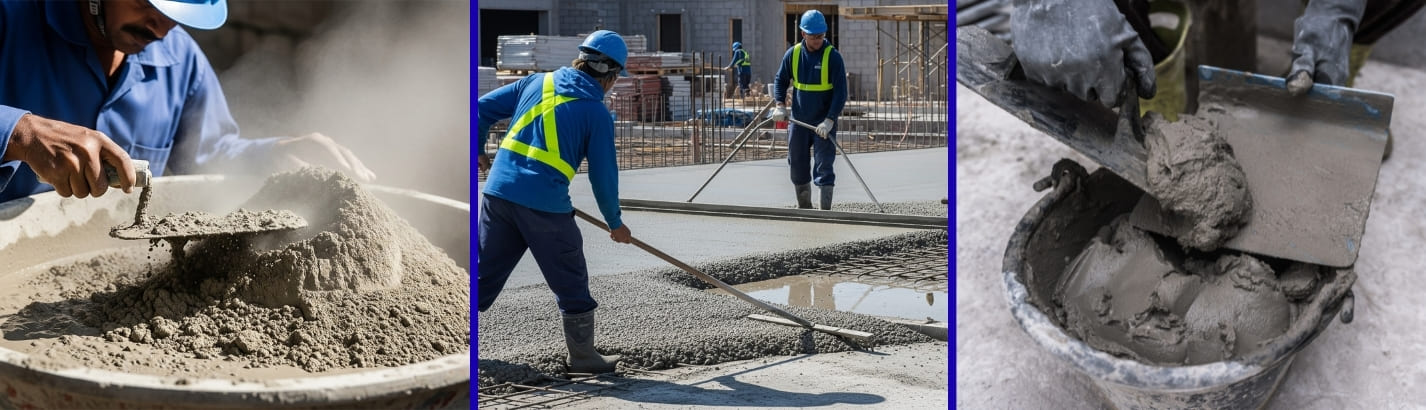
Cement: grey powder
Mortar: thick paste
Concrete: rough mixture with visible stones
7. Use Cases
Cement: preparation of other materials
Mortar: plastering, masonry, tiling
Concrete: structural framework and load-bearing members
Practical Examples
Example 1: Building a Room
The foundation and slab require concrete.
The walls require mortar to bond bricks.
The plaster uses a mortar-like mix.
All mixtures use cement as the binder.
Example 2: Repair Works
Cracks filled with mortar.
Broken slabs repaired using concrete.
Cement paste used for small patch repairs where bonding is needed.
Why Understanding the Difference Matters
Mistakes happen when materials are used without understanding their purpose:
Using mortar instead of concrete leads to weak slabs.
Using concrete instead of mortar reduces bonding between bricks.
Using cement alone leads to severe shrinkage cracks.
Correct material selection increases durability, reduces repair costs, and ensures structural safety.
Conclusion
Cement, mortar, and concrete are closely related but fundamentally different. Cement is the reactive powder that binds mixtures. Mortar is the bonding paste used for masonry and finishing. Concrete is the strong composite material used for structural components. The performance of any building depends heavily on selecting the right material for the right job.

Cookies help us display personalized product recommendations and ensure you have a great experience.
Accept Cookies