A Complete Guide to Concrete Road Construction: Types, Layers, and Applications
- Jan 5
- 5 min read
Road construction in the present day needs materials and techniques that support durability, reduce maintenance, and withstand increasing traffic loads. One such material is concrete, which is a highly reliable solution due to its long lifespan, strength, and cost benefits. In this blog, we are going to talk about how concrete road is constructed, its structural layers, different construction types, and the pros and cons to help understand its suitability better for various use cases.
What is a Concrete Road in Construction?
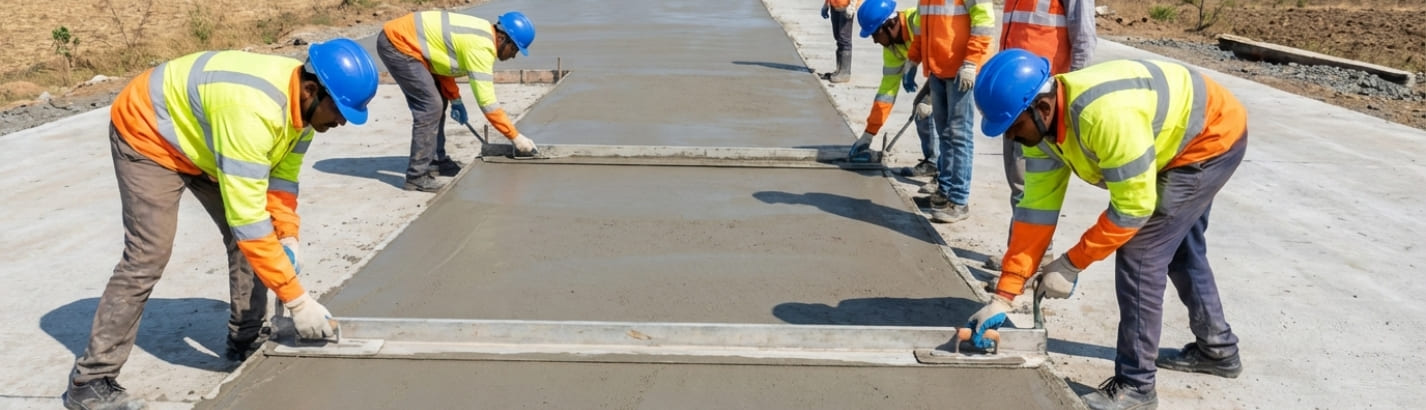
A concrete road is a type of pavement constructed by mixing Portland cement, water, fine aggregate (sand), and coarse aggregate (stone). This mix, once poured and compacted, forms concrete slabs that provide a long-lasting, durable surface.
Unlike flexible pavements like asphalt, concrete material does not deform easily under pressure or develop frequent cracks. The rigidity of the surface offers a longer service life and reduces the need for repairs thus making concrete road the best choice for high-load and high-traffic areas.
What are the Layers of a Concrete Road Construction?
The structural strength and performance of a concrete road depend on the quality and arrangement of its layered components. Each layer has a specific function, working together to distribute traffic load and prevent failures.
1. Surface Course
The topmost layer that directly contacts vehicles.
Typically constructed using concrete material, bituminous mix, or granular layers.
It provides a smooth, robust surface and must resist wear from traffic.
2. Base Course
Located directly under the surface layer.
Distributes vehicle load and adds stiffness to the pavement structure.
Made using compacted granular or bituminous materials.
3. Sub-base Course
A supportive layer beneath the base course.
Prevents the mixing of subgrade soil with the base and supports drainage.
Usually made of stabilized soil or granular materials.
Offers resistance to frost and helps in uniform load transfer.
4. Subgrade
The foundational soil layer prepared through compaction.
Carries the entire load transferred from the pavement layers above.
Its top surface is called the formation level and is designed based on soil type and terrain layout.
Types of Concrete Road Construction
Based on traffic load and site requirements, there are three major types of concrete road construction methods:
1. Jointed Plain Concrete Pavement (JPCP)
JPCP is the most commonly used type for low-volume roads. It consists of concrete slabs separated by joints to manage stress and cracking.
Key Characteristics:
Joint System: Includes both transverse and longitudinal joints to control cracking due to temperature changes or shrinkage.
No Steel Reinforcement: Instead, uses dowel and tie bars at joints to transfer load.
Simplified Maintenance: Faulty slabs can be replaced without disturbing adjoining sections.
Best Use Case: Suitable for urban streets, local roads, and rural paths with light to moderate traffic.
2. Jointed Reinforced Concrete Pavement (JRCP)
JRCP is designed for medium to high traffic volume roads and combines joint placement with steel reinforcement for added strength.
Key Characteristics:
Longer Slabs: Joints are spaced farther apart (up to 50 ft), and steel mesh controls cracking between them.
Steel Reinforcement: Steel helps absorb tensile stress and distributes loads evenly.
Load Transfer: Uses dowel and tie bars to improve load-sharing between slabs.
Best Use Case: Ideal for major highways, industrial zones, and areas with problematic subgrade or seasonal temperature variation.
3. Continuously Reinforced Concrete Pavement (CRCP)
CRCP eliminates joints by using continuous steel reinforcement throughout the slab. It is suitable for very high-traffic zones and infrastructure with long-term usage expectations.
Key Features:
Controlled Cracking: Reinforcement allows micro-cracks to form but prevents them from widening, reducing water infiltration.
No Regular Joints: Offers a smoother ride due to the absence of frequent joints.
Minimal Maintenance: Reinforcement ensures durability and limits the need for frequent repairs.
Best Use Case: Used in ports, airports, expressways, and freight corridors.
Advantages and Disadvantages of Concrete Roads
To evaluate the long-term suitability of concrete road construction, it's important to weigh its strengths against its drawbacks. Below is a structured comparison:
Advantages | Disadvantages |
|---|---|
Durability: Service life of 30–40 years, much longer than asphalt (typically 10 years). | Higher Initial Cost: Involves greater upfront investment due to materials and construction method. |
Low Maintenance: Less prone to potholes, rutting, and cracks | Longer Construction Time: Requires curing; slows down project timelines. |
High Strength: Performs well under heavy loads, ideal for industrial applications. | Less Flexibility: Rigid structure can crack under extreme temperature shifts or settlement. |
Better Fuel Efficiency: Vehicles use 15–20% less fuel due to lower rolling resistance. | Reflective Glare: More reflective than asphalt, may cause visibility issues in bright sunlight. |
Faster Drying: Dries quicker after rain, reducing risk of hydroplaning. | Noise Levels: Generates more tyre noise—can be 2–3 decibels louder than asphalt. |
Concrete road construction offers a reliable and long-lasting solution for different types of roadways. The use of Portland cement, steel reinforcement, and strong concrete material results in durable concrete slabs that require less maintenance over time.
Each type has its own advantages depending on load requirements, environmental conditions, and cost considerations. For infrastructure projects requiring strength, consistency, and performance, concrete road remains a dependable choice across construction applications.

Cookies help us display personalized product recommendations and ensure you have a great experience.
Accept Cookies