What Is Footing in Construction?
- Dec 29
- 6 min read
Footing is one of the most important components of any building structure because it transfers the load from the building to the soil beneath. A well-designed footing ensures that the structure remains stable, safe, and capable of handling long-term pressure without settlement or failure. Without proper footings, even a well-built structure is at risk of cracks, tilting, or collapse. Understanding footing in construction is essential for builders, engineers, students, and homeowners involved in any building project.
Footings form the lowest part of the foundation system. They are typically made of concrete with steel reinforcement and are responsible for spreading the load over a larger area. This prevents excessive soil pressure, especially in regions where soil strength varies. In this guide, you will learn what footing is, types of footings used in construction, how footings work within a foundation system, and factors that influence footing design.
Understanding Footing in Construction
Footing in construction refers to the structural element placed beneath columns, walls, or other load-bearing components. Its primary function is to distribute the weight of the structure evenly across the soil. Footings are designed based on the nature of the structure, the load it carries, and the capacity of the soil. Stronger buildings and weaker soils require larger and deeper footings.
A footing is usually constructed with plain or reinforced concrete. Reinforcement with steel bars helps the footing resist bending and shear forces. The shape and size of a footing depend on the type of building and the loads it must manage. Engineers carefully calculate these factors to prevent unequal settlement, one of the most common reasons for structural cracks.
In simple terms, the footing acts as a bridge between the building and the ground. It ensures that the load is transferred safely without overloading any particular section of soil.
Why Footings Are Important
Footings play a major role in the stability of a building. Their importance can be understood through several functions:
1. Load Distribution
Footings help distribute the entire load of the building over a larger area. This prevents the soil beneath from sinking under concentrated pressure.
2. Prevention of Settlement
Different parts of a building may settle unevenly if the footing is poorly designed. Uneven settlement leads to cracks in walls, floors, and ceilings. A well-built footing prevents such issues.
3. Protection Against Structural Failure
Without strong footings, the building risks sliding or tilting, especially in areas with expansive clay, loose soil, or seismic activity.
4. Stability Under Varying Soil Conditions
Soil properties change with moisture, compaction, and weather. A strong footing stabilizes the building against these changes.
Types of Footing Used in Construction
There are several types of footings, each designed for a specific purpose. Selecting the right one depends on the load, soil type, building design, and site conditions. Below are the most common types of footings used in foundation construction.
1. Isolated Footing
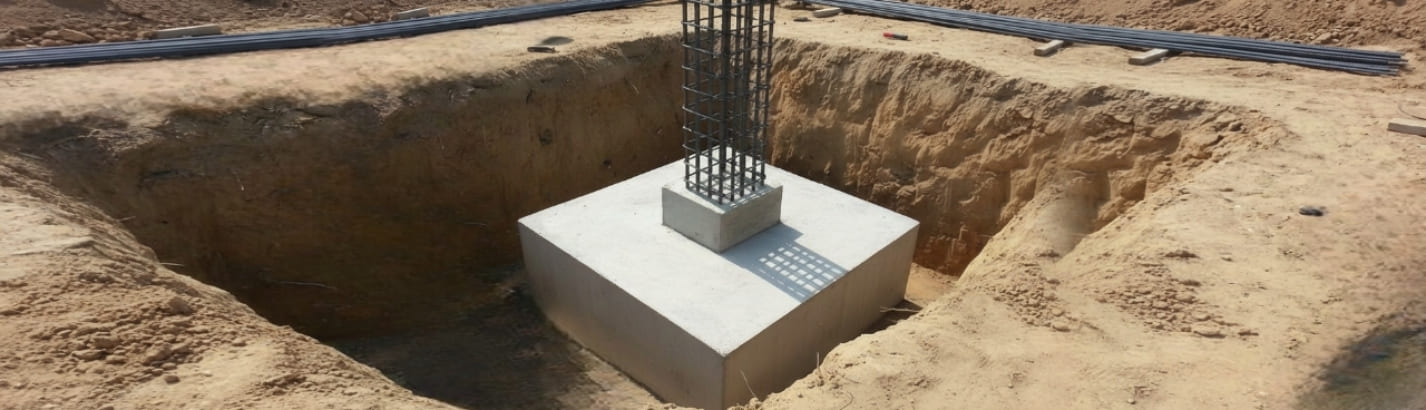
An isolated footing, also known as a single footing, is used to support individual columns. It is one of the most widely used types in residential and commercial buildings. Each column receives its dedicated footing, usually square or rectangular.
When to Use Isolated Footing
Low to moderate load buildings
Good soil conditions
Structures with columns spaced at regular intervals
Characteristics
Economical
Easy to construct
Requires reinforcement to handle bending and shear
2. Combined Footing
Combined footing supports two or more columns when they are close to each other. This type is used when columns cannot have separate isolated footings due to space constraints or when one column is close to a property boundary.
When to Use Combined Footing
Columns closely spaced
Unequal loads on columns
Limited space prevents isolated footings
Characteristics
Rectangular or trapezoidal
Designed to balance load distribution between columns
3. Strap Footing
Strap footing is used when one footing cannot be centered due to site limitations. A strap or beam connects two footings, allowing the combined system to behave similarly to a combined footing.
Suitable Situations
Columns near boundaries
Soil with moderate bearing capacity
Characteristics
The strap beam does not transfer load to the soil
Helps align overall load distribution
4. Strip Footing
Strip footing is used for load-bearing walls. Instead of supporting columns, it runs continuously under walls.
Applications
Masonry wall construction
Low-rise buildings
Characteristics
Helps distribute the wall load uniformly
Rectangular section running along the wall length
5. Raft or Mat Footing
Raft footing is a single large slab supporting all columns and walls in a building. It is ideal for weak or loose soils where individual footings would be too large.
When to Use Raft Foundation
Buildings on soft soils
High load structures
Basements or large floor areas
Characteristics
Acts as one continuous unit
Reduces differential settlement
Reinforcement is used throughout the slab
6. Pile Footing
Pile footing, or pile foundation, is used when the topsoil lacks the strength to support loads. Long concrete or steel piles are driven deep into the ground where stronger soil or rock is present.
Best Suited For
High-rise buildings
Bridges and industrial facilities
Waterlogged or weak soil zones
Characteristics
Transfers load to deeper strata
Very high load-bearing capacity
Suitable for seismic regions
7. Stepped Footing
Stepped footing is mainly used in sloped areas. The footing is constructed in steps to maintain a level base for building construction.
Applications
Hilly terrain
Sites with height differences
Characteristics
Easy to build
Supports masonry walls effectively
Footing vs. Foundation
The terms footing and foundation are often used interchangeably, but they have distinct meanings.
Foundation
This is the overall substructure that transfers loads to the soil. It includes all components below ground.
Footing
Footing is the part of the foundation that directly touches the soil. It is the lowest and widest element.
In simple terms, every footing is part of the foundation, but not every foundation is a footing. Understanding this difference helps in proper planning and selection during construction.
Factors That Influence Footing Design
Several factors must be considered while designing a footing to ensure safety and performance.
1. Soil Bearing Capacity
Soil tests help determine how much load the soil can support. Weak soils need larger and deeper footings.
2. Building Load
Heavier structures need stronger footings with increased thickness and reinforcement.
3. Groundwater Level
High groundwater levels affect footing stability and require careful waterproofing measures.
4. Climate and Environmental Conditions
Areas with wet seasons, frost, or seismic activity need specialized footing designs.
5. Type of Structure
Homes, warehouses, commercial buildings and industrial units each have different load patterns. Footings are designed accordingly.
Construction Process of Footings
Footing construction follows a series of steps to ensure accuracy and safety.
1. Site Excavation
The soil is excavated to the required depth based on design.
2. Leveling and Compacting
The base is leveled and compacted to avoid uneven settlement.
3. Laying PCC (Plain Cement Concrete)
A lean concrete layer is placed below reinforcement to create a smooth working surface.
4. Placing Reinforcement
Steel bars are arranged as per the structural drawing to resist bending forces.
5. Shuttering
Formwork is placed to give the footing its shape.
6. Concrete Pouring
Concrete is poured, vibrated, and leveled to avoid voids.
7. Curing
Proper curing is carried out to ensure strength gain and avoid cracks.
Final Thoughts
Footing in construction is a critical element that determines the safety and longevity of a building. By distributing loads effectively and stabilizing the structure, footings protect the building from settlement and structural issues. Choosing the right type of footing depends on soil conditions, building load, and design requirements. Whether it is an isolated, combined, raft, or pile footing, each type serves a distinct role in foundation construction.

Cookies help us display personalized product recommendations and ensure you have a great experience.
Accept Cookies