A Brief Guide to Combined Footing: Types, Use Cases, Advantages, and Disadvantages
- Nov 14
- 4 min read
The foundation is the most crucial part of any building construction, as it carries the entire load of the structure and transfers it safely to the ground. Among various types, shallow foundations are commonly used in residential and mid-rise urban construction projects due to their cost-effectiveness and suitability for moderate loads. In scenarios where two or more columns are placed close to each other, combined footing becomes essential, especially in space-constrained urban plots or uneven soil conditions.
What is a Combined Footing?
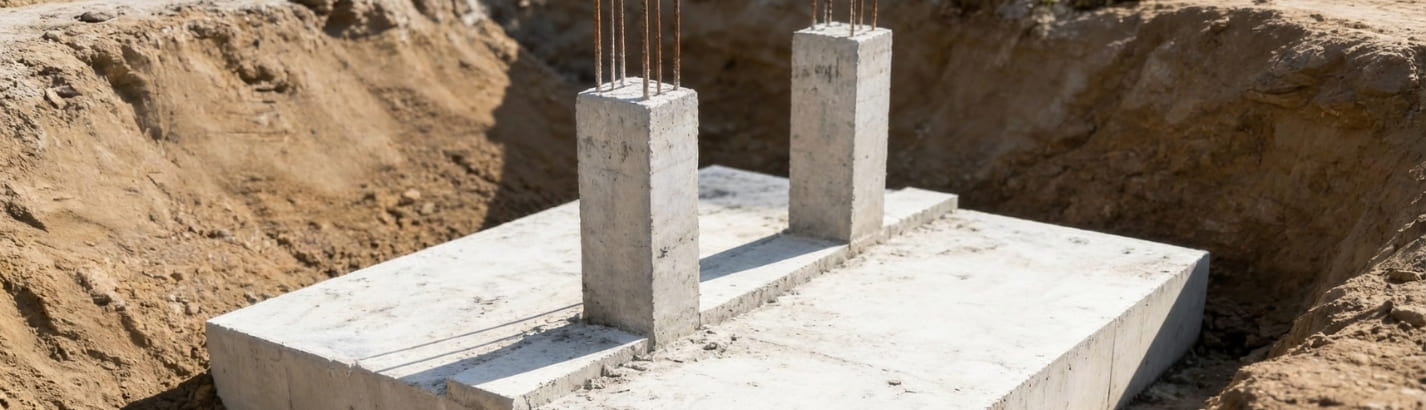
Combined footing is a type of shallow foundation that supports two or more columns in construction using a single continuous concrete base. Unlike isolated footings which support individual columns, this footing merges support for multiple columns into one slab or two columns in one strap or beam footing, ensuring even load distribution and structural balance. It is typically used when the spacing between columns is too narrow for separate footings or when one column lies near a property boundary, making the placement of an individual footing impractical. The rectangular or trapezoidal shape of a combined footing helps manage varied loads and prevents unequal settlement, particularly on weak or variable soil.
Best Use Cases for Combined Footing
Combined footing proves useful in several specific construction scenarios:
Limited Space Situations: In dense urban construction environments where columns are close together, combined footings eliminate the risk of footing overlap.
Load Distribution on Poor Soil: When soil has low bearing capacity, combining footings helps spread the load more evenly, reducing the risk of differential settlement.
Proximity to Property Boundaries: Near boundary walls, individual footings might not fit within the allowed limits; combined footings solve this without compromising stability.
Varied Load Management: When columns in construction carry different loads, the footing can be proportioned to accommodate the difference, maintaining structural integrity.
Cost Efficiency: Instead of constructing multiple isolated footings, one combined footing saves on excavation, formwork, and concrete costs, making it a practical option in modern construction.
Types of Combined Footing
Depending on the load conditions and column arrangement, there are several types of combined footing used in building construction:
Rectangular Combined Footing: Used when two columns carry similar loads and are aligned symmetrically. The rectangle shape ensures balanced distribution and is suitable for residential and small commercial projects.
Trapezoidal Combined Footing: Applied when columns carry unequal loads or are asymmetrically positioned. The wider end supports the heavier column, ensuring uniform soil pressure.
Slab Type Combined Footing: A large slab supports a row of columns, typically used where soil is weak or the structure is heavy. This form offers simplicity and stability.
Strap Combined Footing: Also called cantilever footing, this involves two isolated footings connected by a strap beam. It’s used when one column is close to a boundary and needs off-center support.
Suitability of Combined Footing
The use of combined footing is influenced by several factors:
Closely Spaced Columns: When columns in construction are too close for isolated footings.
Unequal Column Loads: For managing different load intensities between adjacent columns.
Soil Conditions: Effective when bearing capacity is limited or settlement control is required.
Architectural Layout Constraints: Supports design flexibility in restricted plots or irregular building plans.
Structural Efficiency: Ensures uniform pressure under the foundation and aligns with the column loads’ centroid.
Economic Considerations: Often more affordable than providing separate footings for each column in constrained sites.
Advantages and Disadvantages of Combined Footing
The following table clearly points out the key advantages and disadvantages of Combined Footing:
Advantages | Disadvantages |
|---|---|
Uniform load distribution from multiple columns | More complex design and engineering requirements |
Optimised use of space in tight urban plots | Limited load-bearing capacity for high-rise structures |
Cost savings on material and labour | Time-intensive construction process |
Better performance on poor soils | Difficult to modify or expand later |
Flexibility in footing shapes and types | May not suit changing soil conditions |
Architectural freedom for dense layouts | Not ideal for buildings needing frequent structural changes |
In modern construction, environments where space is restricted and load management is critical, combined footing offers a reliable and economical foundation solution. It ensures even weight distribution, reduces material usage, and accommodates site-specific constraints. However, it demands careful planning and consideration of soil conditions, load variations, and design needs. When implemented correctly, combined footing significantly contributes to the structural stability and efficiency of any building construction project.

Cookies help us display personalized product recommendations and ensure you have a great experience.
Accept Cookies