What Is a Precast Concrete Slab?
- Apr 6
- 6 min read
Concrete is the backbone of modern construction. Whether you’re building floors, bridges, parking structures, walls, or industrial buildings, concrete provides the strength and durability needed for long service life. But not all concrete is made the same way. Over the years, two major construction methods have developed: precast concrete and cast-in-situ (or in-situ cast) concrete.
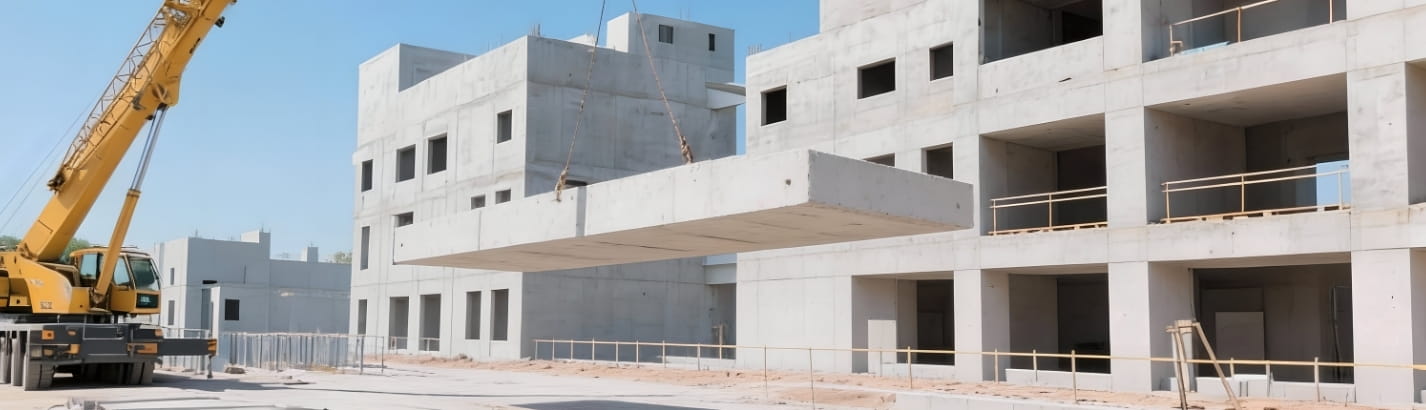
Among the most widely used precast elements today are precast concrete slabs structural floor and roof components manufactured off-site and installed quickly on the construction location. This blog explores what a precast concrete slab is, how it is made, how it differs from cast-in-situ concrete, and which method is best for different building scenarios.
What Is a Precast Concrete Slab?
A precast concrete slab is a flat, structural panel made of reinforced or prestressed concrete that is manufactured in a controlled factory environment, cured at the plant, and then transported to the jobsite for installation.
Instead of pouring concrete on the construction site, precast slabs are produced using standardized molds and curing techniques, which guarantees consistent quality, uniform strength, and high durability.
Precast slabs come in several forms, including:
1. Solid Precast Slabs
These are simple, fully solid concrete panels used in residential floors, small commercial projects, and wall panels. They offer good load-bearing capacity and reduce on-site labor.
2. Hollow-Core Slabs
One of the most commonly used precast elements, hollow-core slabs (HCS) contain longitudinal voids. These reduce weight, lower material consumption, and allow longer spans with minimal beams or supports. They are ideal for apartment buildings, parking garages, and industrial structures.
3. Double Tee Slabs
Double tee or “TT” slabs combine a thin slab with two parallel beams. They provide extremely long spans and are widely used in parking decks, bridges, and roofing systems.
4. Composite Slabs
These incorporate steel decking or topping concrete to create hybrid floor systems, improving stiffness and vibration control.
Regardless of the type, the key characteristic of a precast slab is that it is produced before arriving on-site, which brings numerous advantages to the construction process.
How Are Precast Concrete Slabs Manufactured?
The manufacturing of precast slabs involves a series of controlled steps designed to ensure high quality and durability:
1. Mold Preparation
Slabs are cast in steel, aluminum, or rubber molds. These molds are highly precise, allowing manufacturers to produce identical units repeatedly.
2. Reinforcement or Prestressing
Depending on the design, steel reinforcement bars or prestressed tendons are placed inside the mold. Prestressing significantly increases load capacity and reduces cracking.
3. Concrete Pouring
High-strength concrete, often with carefully monitored mix proportions, is poured into the mold.
4. Mechanical Vibration and Compaction
Machines vibrate the mold to eliminate air pockets and ensure proper compaction.
5. Curing Under Controlled Conditions
Unlike on-site concrete, which depends on weather conditions, precast slabs are cured in temperature-controlled chambers. This ensures consistent strength, minimal shrinkage, and faster production times.
6. Transportation and Installation
Once cured, slabs are shipped to the site and installed using cranes. Joints are grouted or sealed, and connections are reinforced as needed.
The entire process focuses on quality, speed, and efficiency.
Advantages of Precast Concrete Slabs
Precast slabs offer several important benefits:
1. Faster Construction
Since the slabs are manufactured ahead of time, construction schedules become more predictable. Installation takes hours instead of days.
2. High Quality and Strength
Factory-controlled curing and casting produces stronger and more durable slabs than typical site-cast concrete.
3. Reduced On-Site Labor
With prefabricated elements, the site crew only needs to install and secure the slabs, greatly reducing manpower and labor costs.
4. Cleaner and Safer Site
Minimal concrete mixing and curing on-site means less dust, waste, noise, and congestion.
5. Weather-Independent Production
Slabs are produced indoors, unaffected by rain, heat, or cold, ensuring consistent quality year-round.
6. Long Spans and Design Flexibility
Hollow-core and double-tee slabs can cover large distances without beams or intermediate supports, providing open, flexible interior spaces.
7. Sustainability
Less cement, reduced material wastage, and efficient manufacturing lead to a lower environmental footprint.
What Is Precast Concrete?
Precast concrete refers to any concrete element that is cast, cured, and finished in a controlled manufacturing facility before being transported to the construction site.
This includes slabs, beams, columns, walls, pipes, manholes, and more. Precast concrete is known for:
Quality control
Precision engineering
Consistency in strength and dimensions
Faster project delivery
Precast systems are widely used in commercial buildings, industrial plants, highways, and public infrastructure due to their reliability and speed.
What Is Cast-In-Situ Concrete?
Cast-in-situ (or cast-in-place) concrete is mixed, poured, and cured directly at the construction site. Traditional concrete slabs, beams, and columns in residential and commercial construction are usually cast in place.
The process involves:
Building formwork
Pouring concrete
Vibrating and compacting
Allowing it to cure on-site
While this method provides excellent design flexibility, it is slower and more dependent on weather, labor skill, and site conditions.
Precast Concrete vs Cast-In-Situ Concrete
Here is a helpful comparison:
1. Construction Speed
Precast: Very fast; elements are simply installed.
Cast-in-situ: Slow; requires formwork, curing, and large labor teams.
2. Quality Control
Precast: High; controlled environment ensures uniform strength.
Cast-in-situ: Variable; depends on weather, workmanship, and site conditions.
3. Cost
Precast: Higher initial cost but lower long-term labor and maintenance.
Cast-in-situ: Lower initial cost but higher labor and longer schedules.
4. Flexibility
Precast: Limited custom shapes without special molds.
Cast-in-situ: Highly flexible; easily accommodates unique designs.
5. Strength and Durability
Precast: Consistently strong; less prone to shrinkage and cracking.
Cast-in-situ: Strength varies; more sensitive to curing conditions.
6. Site Conditions
Precast: Ideal for congested or weather-challenged sites.
Cast-in-situ: Better suited for remote or hard-to-access sites.
When Should You Use a Precast Concrete Slab?
Precast slabs are ideal when:
You need fast construction (e.g., commercial buildings, warehouses)
Long spans without many columns are required
Quality and uniformity are crucial
On-site labor or space is limited
Weather conditions are unpredictable
You need minimal structural depth
They are widely used in:
Residential apartments
Parking structures
Schools and hospitals
Industrial buildings
Shopping malls
Stadiums
Bridges and transportation hubs
When Is Cast-In-Situ Concrete Better?
Cast-in-situ is usually preferred when:
Complex shapes or custom designs are needed
Construction sites are far from precast factories
Small projects with simple floor plans are involved
There is plenty of labor and space on-site
It remains the most common method for houses, boundary walls, small commercial units, and foundations.
Conclusion
A precast concrete slab is a pre-manufactured structural concrete panel designed for strong, fast, and efficient construction. It offers significant benefits over cast-in-situ concrete in terms of speed, quality, safety, and long-span capability. While cast-in-situ concrete still has its place in flexible and custom designs, precast systems are quickly becoming the preferred option for modern projects that demand reliability and rapid completion.
By understanding the differences between precast and cast-in-situ concrete, builders, engineers, and homeowners can make informed decisions that improve project timelines, reduce costs, and enhance long-term performance.

Cookies help us display personalized product recommendations and ensure you have a great experience.
Accept Cookies