A Home-Builder’s Evaluation of Structural Systems in Residential Construction: Load-Bearing vs RCC Frame Structure
- Mar 4
- 6 min read
Evaluation Aspect | Load-Bearing Structure | RCC Frame Structure |
|---|---|---|
Load Transfer System | Masonry walls carry roof and floor loads directly to the foundation; walls are structural | Slab transfers load to beam, beam to column, column to foundation; walls are non-structural partitions |
Height & Expansion | Suitable for single-storey to about 2–3 storeys; limited suitability for taller buildings | Suitable for multi-storey construction; supports planned or future vertical expansion |
Layout & Openings | Wall positions are structural; limited large openings, wide spans, and cantilevers | Internal walls are flexible; larger openings, wider spans, and cantilevers can be incorporated |
Soil Suitability | Concentrated wall loads; less suitable for weak or highly variable soils | Column-based load distribution; can accommodate raft or pile foundations |
Seismic Performance | Limited flexibility under lateral forces; comparatively weaker in seismic zones | Provides improved resistance to earthquake forces when properly designed |
Durability Considerations | Moisture penetration may affect masonry if damp-proofing or drainage is inadequate | Improper mix, curing, or reinforcement protection may lead to cracking or corrosion |
Overall Suitability | Appropriate for low-rise homes on stable soil with limited layout changes | Appropriate for taller buildings, flexible layouts, weak soil, and seismic conditions |
In residential building construction, the structural system defines the way loads are transferred, spaces are planned, and how future modifications can be handled. For most homes, the comparison for such factors happens to be between a load-bearing system and an RCC frame structure. The decision should be based on height, soil condition, layout requirements, budget, long-term intent and finally, durability. So let us find out the appropriate choice that a homebuilder should make between these two in consideration to the future projection of a building.
Structural Behavior and Load Transfer
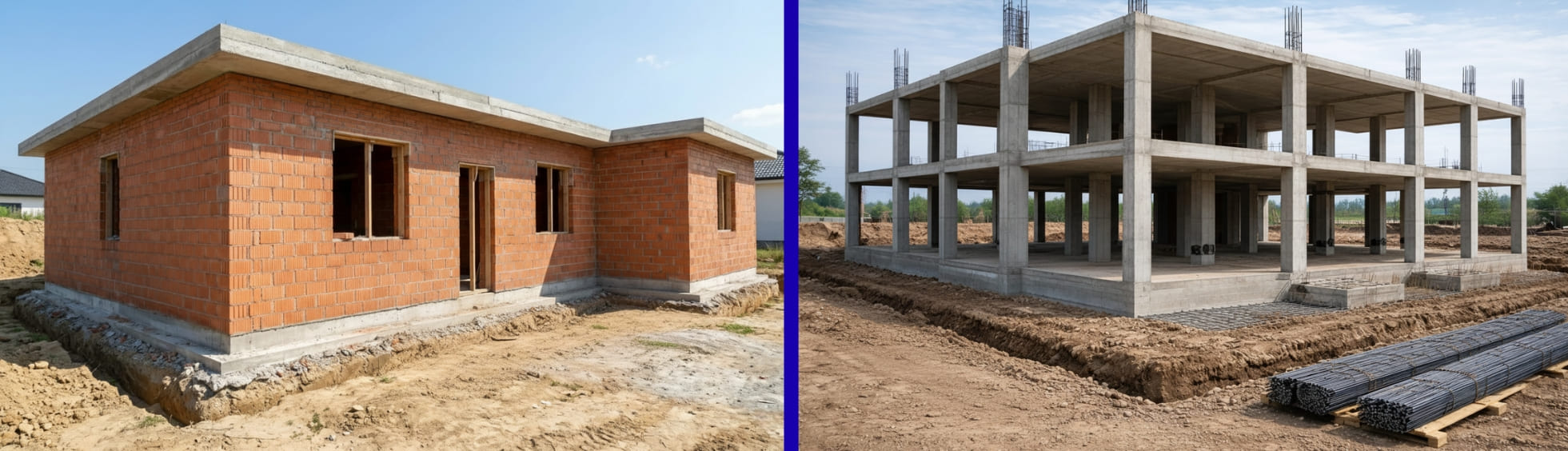
A load-bearing structure relies on masonry walls to carry the weight of the building. The roof and floors rest directly on the walls, and these walls transfer the load to the foundation. The walls are structural members and cannot be treated as removable partitions. Materials such as stone or brick walls are commonly used. Since the walls carry structural loads, openings must be carefully planned and cannot be arbitrarily increased.
In contrast to that an RCC frame structure uses a structural skeleton made of reinforced cement concrete. The load path follows a defined sequence where the slab transfers load to the horizontal beam, the beam transfers it to the vertical column, and the column transfers it to the building foundation. The walls in this system act as non-structural partitions and do not carry the building load.
This difference directly affects flexibility, potential for future expansion, and design freedom.
Building Height and Vertical Expansion
Load-bearing structures are generally suitable for low-rise buildings. They are commonly used for single-storey or maximum two to three-storey homes. Structural limitations make them less appropriate for taller buildings because masonry walls are not designed to handle high tensile stresses or large spans.
An RCC frame structure is suitable for multi-storey construction. The reinforced concrete frame is designed to handle higher loads and greater structural demands. This makes it more appropriate when additional floors are planned either immediately or in the future.
For a homebuilder considering vertical expansion, the framed system provides greater structural capacity.
Layout Flexibility and Spatial Planning
In a load-bearing system, the position of walls determines structural stability. Removing or relocating a structural wall is not feasible without affecting safety. Large openings are limited, and wide spans are difficult to achieve. Cantilever elements are also restricted.
In an RCC frame structure, the structural load is carried by columns and beams. Internal walls can be positioned based on functional needs rather than structural constraints. Larger openings and wider spans can be incorporated because the frame carries the load. Cantilever projections are also easier to accommodate within the structural design.
For homes requiring open layouts, flexible room configurations, or potential future modifications, the framed system provides structural freedom that a load-bearing system cannot offer.
Soil Conditions and Foundation Suitability
Soil type significantly influences the choice of a building structure.
Load-bearing walls exert concentrated pressure along wall lines. In weak soils such as loose alluvial soil or black cotton soil, differential settlement can occur. This can lead to cracks or structural distress if not properly managed. For this reason, load-bearing systems are less suitable for weak or highly variable soils.
An RCC frame structure distributes loads through the column network and can accommodate foundation solutions such as raft foundations or pile footings. This allows better handling of soil movement and uneven settlement conditions. In areas with poor soil quality, a framed structure is generally more appropriate.
Seismic Performance
Seismic resistance is an important consideration in many regions.
Load-bearing masonry structures have limited flexibility under lateral forces. Unreinforced masonry walls are particularly vulnerable during earthquakes and may develop cracks at joints and corners. Performance in seismic zones is comparatively weaker.
An RCC frame structure, when properly designed, provides improved resistance to earthquake forces. Reinforced concrete frames can incorporate ductile detailing and other structural provisions that improve performance under lateral loading. For construction in seismic zones, the framed system offers stronger structural behaviour when designed according to standards.
Durability and Maintenance Factors
Both structural systems require quality construction practices.
In load-bearing systems, inadequate damp-proofing or poor drainage can allow moisture penetration into masonry walls. Over time, this can affect structural integrity and interior finishes.
In an RCC frame structure, issues such as improper concrete mix, inadequate curing, or insufficient reinforcement protection can lead to cracking, corrosion of reinforcement, or surface deterioration. Proper construction supervision and adherence to standards are essential.
With correct design and maintenance, both systems can provide long service life. Reinforced concrete structures are commonly designed for long-term durability when maintained appropriately.
The choice between a load-bearing system and an RCC frame structure should be based on structural suitability rather than preference. Load-bearing construction offers cost advantages for small, low-rise homes built on stable soil with limited layout changes. A framed system built with reinforced cement concrete provides greater flexibility, better performance in challenging soil and seismic conditions, and suitability for taller structures.
For a homebuilder, the correct decision comes from aligning structural capacity with intended building height, soil condition, layout requirements, and long-term expansion plans. A clear evaluation of these factors ensures that the structural system supports the home safely and efficiently throughout its service life.

Cookies help us display personalized product recommendations and ensure you have a great experience.
Accept Cookies