Load-Bearing Structure VS. RCC Frame Structure - The Key Differentiating Points
- Jan 27
- 4 min read
In urban housing, the structural system you choose affects cost, safety, flexibility, and future expansion. Load-bearing structures are cheaper and simpler but limited to low-rise buildings with rigid layouts. RCC frame structures cost more but support taller buildings, allow flexible design, and offer better safety in seismic zones. The right choice depends on your project’s scale, budget, and long-term needs.
In any construction project, the structural system forms the backbone of a building’s strength, durability, and long-term use. Among the most widely adopted options in residential and urban housing are the Load-Bearing Structure and the RCC Frame Structure. Understanding their composition, performance, and suitability is critical for making the right structural choice.
What is a Load-Bearing Structure?
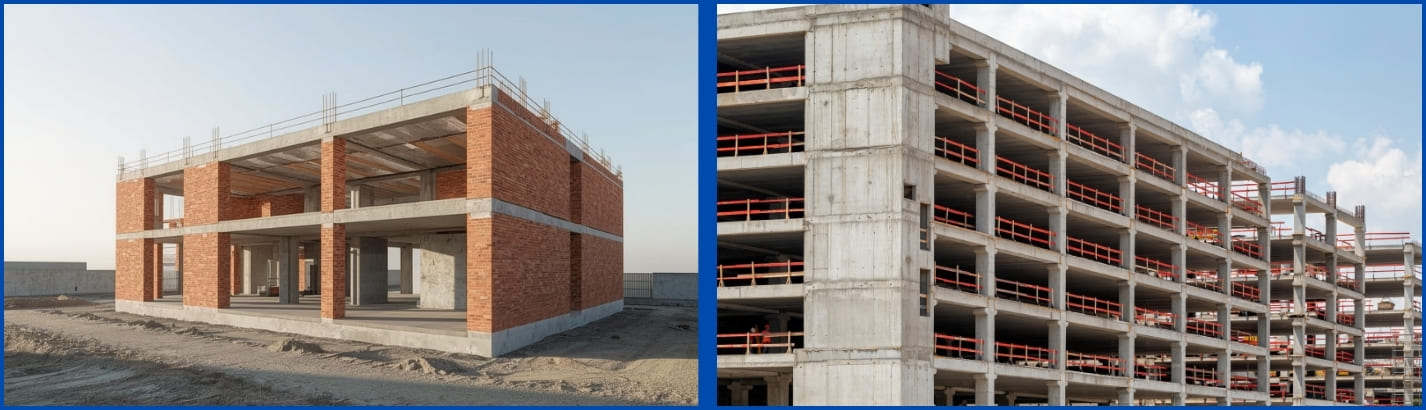
A Load-Bearing Structure is a traditional construction system where the walls serve as the primary structural elements. These walls directly carry the building's weight from roof to foundation without using a frame of columns or beams usually.
Key characteristics include:
The structure does not usually include a column-beam framework.
Walls are constructed using durable materials such as stone, brick, or concrete, capable of withstanding vertical and lateral loads.
Doors and windows are limited due to structural limitations.
These structures are considered suitable primarily for low-rise buildings.
This method is widely used in smaller homes where design flexibility is less critical, and cost efficiency is a primary concern.
What Is an RCC Frame Structure?
An RCC Frame Structure short for reinforced concrete frame uses a grid of interconnected columns, beams, and slabs to transfer loads. This skeletal framework handles both vertical and lateral forces, with non-load-bearing walls used only for partitions.
Core features include:
Structural loads are transferred from the slab to the concrete beam, from the beam to the construction column, and then to the foundation.
The framework can extend in two or three dimensions and is ideal for handling large loads and forces.
Walls do not carry structural loads, enabling greater flexibility in layout and design.
Materials like reinforced concrete, steel, or timber may be used depending on project requirements.
This system is ideal for multi-story buildings, commercial complexes, or housing projects that demand wider spans and future expansion.
Load-Bearing vs RCC Frame: Key Differences
Here’s a simple comparison to understand how these two structural systems differ across essential parameters.
Criteria | Load-Bearing Structure | RCC Frame Structure |
|---|---|---|
Load Distribution | Walls carry structural loads | Loads handled by columns and beams; walls are non-structural |
Materials Used | Brick, stone, concrete blocks | RCC, steel, timber |
Design Flexibility | Low—layout depends on structural walls | High—walls can be repositioned |
Construction Speed & Cost | Slower and more labor-intensive | Faster, but with higher initial costs |
Height & Span | Limited to low-rise and small spans | Suitable for high-rise and large spans |
Maintenance & Modifications | Difficult to alter once built | Easier to renovate |
Cantilever Elements | Limited to short spans | Easily accommodated |
Wall Openings | Restricted by structural requirements | Large openings possible |
What are the advantages and disadvantages of RCC Frames and Load-Bearing Structures?
Depending on the nature of the building project, each structural method offers specific advantages and challenges. The following table explains it clearly:
Structure Type | Advanatages | Disadvantages |
|---|---|---|
Load-Bearing Structure | Cost-effective for small and low-rise buildings Simple construction process with basic techniques Uses commonly available materials like brick and stone Good fire resistance due to masonry construction | Slower and more labour-intensive construction Heavy walls increase the load on the foundation Limited thermal insulation compared to modern systems Poor performance in seismic zones due to low flexibility Not suitable for high-rise buildings or future vertical expansion |
RCC Frame Structure | Allows flexible layouts and open spaces High strength and durability due to reinforced concrete Faster construction with prefabricated components Suitable for residential, commercial, and industrial buildings Better resistance to earthquakes when properly designed | Higher initial construction cost Requires skilled engineering and careful planning Steel components may need corrosion protection Higher thermal conductivity without proper insulation Additional fireproofing may be required for steel elements |
The choice between a Load-Bearing Structure and an RCC Frame Structure depends on several factors, such as building height, function, budget, regulatory norms, and flexibility needs. For compact residential projects with limited height and budget, a Load-Bearing Structure may suffice. However, for structures requiring larger spans, vertical expansion, or high resistance to seismic forces, an RCC Frame Structure is the more appropriate choice.

Cookies help us display personalized product recommendations and ensure you have a great experience.
Accept Cookies