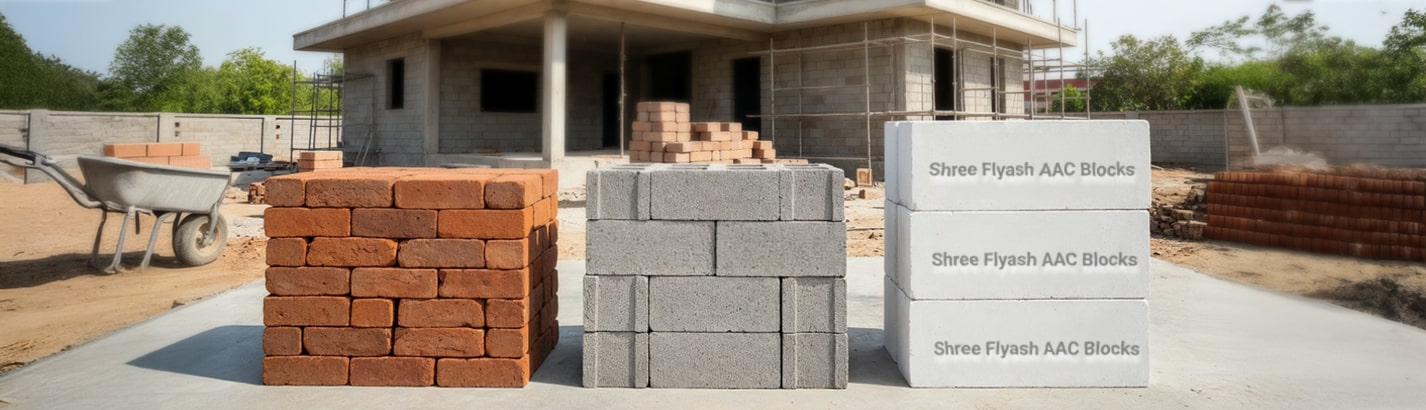
Modern House Construction: Bricks, Blocks, or Concrete?
- Dec 3
- 3 min read
When planning a new house construction, one of the biggest decisions is choosing the right building material for your walls. The traditional choice of red bricks is now just one of many options.
The bricks vs blocks debate has become more complex with the rise of solid concrete blocks and lightweight AAC blocks.
This choice affects your budget, construction speed, and the long-term comfort of your modern house.
Here’s a direct comparison to help you understand the options.
1. Traditional Red Bricks
This is the classic building material everyone is familiar with.
Pros: They are dense, durable, and have good "thermal mass," meaning they slow down heat transfer. Their quality and performance are well-understood.
Cons: Quality can be inconsistent. They are heavy, which adds more load to the building's foundation. The laying process is slow, requires more water (a "wet" construction), and uses more mortar per square foot.
2. Concrete Blocks (Solid and Hollow)
These are the most direct alternative to bricks.
Pros: They are uniform in size and strength (unlike bricks, which can be overburnt or underburnt). Because they are larger, construction is much faster, and they use less mortar. They are generally more cost-effective.
Cons: Solid concrete blocks are very heavy. Their thermal insulation isn't as good as other materials, meaning your home can get hot.
Please note that some concrete blocks, especially hollow blocks, are not suitable for load bearing walls.
3. AAC (Autoclaved Aerated Concrete) Blocks
The AAC Block is rapidly gaining popularity. It is a lightweight, foam-like concrete block. Quality AAC blocks can have higher compressive strength than traditional red bricks whale being significantly lighter.
Pros: Extremely lightweight (about 1/3rd the weight of bricks), which significantly reduces the steel and concrete needed in the foundation. They are easy to cut, shape, and install, making construction very fast. Their biggest advantage is excellent thermal insulation, which can lower your air conditioning bills.
Cons: They are more brittle than bricks and can be damaged during transport. They also require different plastering techniques.
For more information, visit our page on Brick vs. Concrete Block: Choose The Best Building Material.
FAQs
Which is better, concrete blocks or bricks?
"Better" depends on your priority. Red bricks offer a traditional, dense wall. Solid concrete blocks are faster and more economical. However, for a modern house, AAC blocks are often considered superior because they are lightweight (reducing structural cost) and provide excellent insulation.
Which block is best for house construction?
For overall performance (insulation, speed, and reduced dead load), AAC blocks are widely considered the best modern choice. For pure strength in load-bearing walls, solid concrete blocks are excellent.
What are the disadvantages of block houses?
The main disadvantages depend on the block. For solid concrete blocks, the disadvantage is poor thermal insulation. For AAC Blocks, the disadvantages include being more brittle before installation and requiring specific types of mortar and plaster.
What are the materials used in building?
A house uses a system of materials:
Structure: Cement, Steel, Bricks or AAC Blocks, Sand, and Stone (often as Ready Mix Concrete).
Walls (Infill): Red Bricks, Solid Concrete Blocks, or AAC Blocks.
Finishing: Plaster, Paint, Tiles, Windows, and Doors.
How much material is required for a 1500 sq ft house?
The amount of steel and concrete depends on the structural design. The number of bricks vs. blocks changes dramatically; because blocks are larger, you would need far fewer of them than bricks to build the same wall. Your architect's official "Bill of Quantities" (BOQ) or contractor’s quotation will be the only document that can answer this accurately.

Cookies help us display personalized product recommendations and ensure you have a great experience.
Accept Cookies