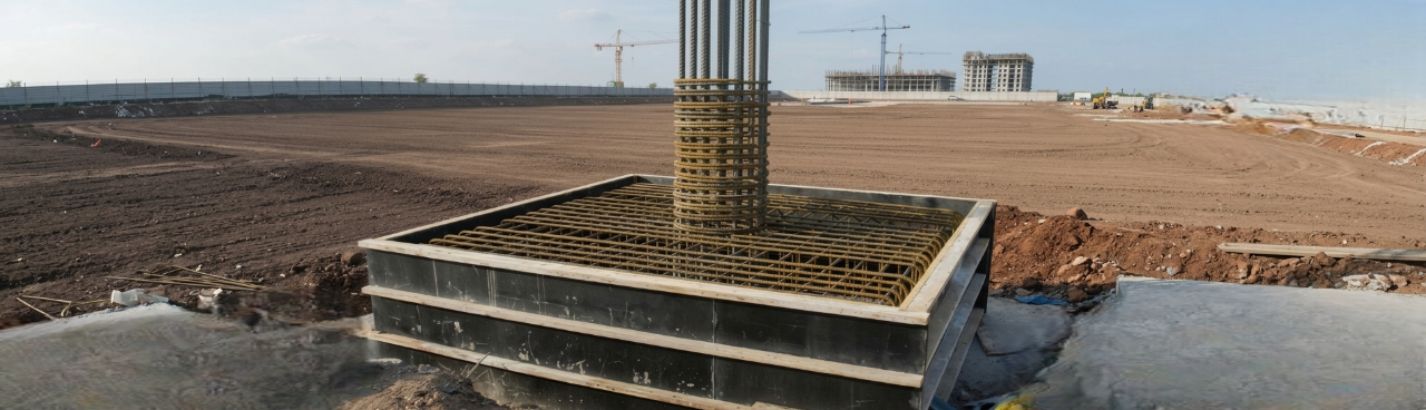
Understanding Grillage Foundation: A Trusted Base for Challenging Soil Conditions
- Jan 15
- 4 min read
In any construction project, this forms the structural base of a building where its main role happens to be to safely transfer loads to the ground below. Among the various types of foundation, each is chosen based on structural load and soil condition. When structures are built on soil which is soft, compressible, or prone to moisture, a Grillage Foundation becomes the best solution. This is because this specific type of foundation provides a stable base for heavy loads without deep excavation or high material costs.
What is a Grillage Foundation?
A Grillage Foundation is a layered framework designed to distribute heavy structural loads over a wider surface area. It typically consists of multiple steel or timber beams arranged in both horizontal and vertical settings to form a structure that resembles a grid. These are embedded in concrete to form a grid-like structure that spreads pressure evenly across the soil.
This type of foundation is especially suitable for projects on weak soil, where traditional methods may risk the consequences of poor soil condition or excessive settlement. It prevents uneven ground movement by reducing pressure intensity on the soil. Engineers often choose it for projects where high load-bearing is essential but the site has limited bearing capacity or strict excavation limits.
What are the Different Types of Grillage Foundation?
Grillage foundations are broadly classified based on the material used and layout pattern. The two most common types are:
Steel Grillage Foundation
This foundation uses steel beams arranged in two or more layers, with the bottom tier carrying heavier beams and the upper layer using lighter ones. The grid is then encased in concrete to form a rigid platform. Steel grillage is used in permanent structures such as industrial buildings, transmission towers, and bridges, where high durability and load-handling are critical.
Timber Grillage Foundation
Made with treated timber beams placed in a crisscross pattern, this variant is usually adopted for temporary setups or low-cost construction where timber is locally available. While easier to install, timber grillage is not suited for permanent structures due to its lower strength and susceptibility to decay.
How is a Grillage Foundation Constructed Step by Step?
The construction of a Grillage Foundation involves several well-defined steps:
Site excavation: The area is cleared and dug to a shallow depth based on load and soil studies.
Soil preparation: The ground is leveled and compacted. A sand or gravel layer may be added to assist in drainage and stability.
Grill placement: Steel or timber beams are laid in layers. First the bottom layer, then the second at right angles, forming a sturdy grid.
Reinforcement material: Steel bars may be added, especially in steel foundations, to improve strength and minimize deflection.
Concrete Pouring: Concrete is poured over and around the beams to fix them in position. This ensures that the beams act as a single unit.
Curing: The concrete is allowed to cure for at least 7 days to achieve sufficient strength.
Inspection: The alignment, level, and structural consistency are checked before moving to superstructure construction.
The Process of Installing a Grillage Foundation
Installing a Grillage Foundation requires care at every stage to ensure uniform load distribution and long-term performance:
Prepare and level the site excavation area.
Lay steel or timber beams in the specified configuration.
Align and level all elements accurately to avoid tilting or settlement.
Use anchoring where required, especially in seismic or flood-prone zones.
Perform quality checks to verify alignment, connection strength, and material compliance before proceeding.
Applications of Grillage Foundation
Grillage foundations are commonly used in structures that demand high stability on soft or variable soil:
Transmission towers: To counteract vertical and lateral loads in unstable ground.
Overpasses and bridges: Beam grids offer a stable base for piers exposed to dynamic vehicular loads.
Factories and warehouses: Ideal for supporting heavy machinery by spreading the load evenly.
High-rise buildings: Helps in preventing uneven settlement and maintaining structural balance over time.
Advantages and Disadvantages of Grillage Foundation
Here are a few points of advantages and disadvantages of a Grillage Foundation:
Advantages | Disadvantages |
|---|---|
Even load distribution reduces settlement risk. | Not ideal for areas with high water tables or very poor soil condition. |
Saves time and cost due to shallow depth. | Requires skilled labor for precision installation. |
Offers design flexibility with steel or timber options. | Timber grillages are unsuitable for permanent, heavy structures. |
Minimizes soil erosion and movement. | May need corrosion protection in steel grillage foundation. |
The Grillage Foundation is a reliable choice for projects requiring broad load distribution, especially in weak or compressible soils. Accurate planning, proper use of reinforcement material, and quality concrete pouring are essential to ensure stability and performance.
Before opting for a Grillage Foundation system, consult a structural engineer to assess feasibility based on load, soil condition, and project needs.

Cookies help us display personalized product recommendations and ensure you have a great experience.
Accept Cookies